\(2^n\mathrm{-tree}\) Theory
| Author: | Mitch Richling |
| Updated: | 2025-06-27 |
This document is still a work in progress; however, I have managed to list many of basic ideas and related mathematical relationships. For a working implementation of the ideas presented below, see the
MRPTreepackage.
Table of Contents
1. Introduction
A quadtree is a nested 2D multi-resolution rectangular mesh. We start with a rectangular region of \(\mathbb{R}^2\) and split it up into sub-rectangles. We then continue the process with each of these new rectangles. An octree is the obvious generalization of the quadtree to 3D – start with a cube, and recursively break it up into sub-cubes. The recursive structure of these structures makes them a a natural fit with tree data structures.
It's a simple exercise to mathematically generalize quadtrees and octrees to \(2^n\mathrm{-trees}\); however, generalizing computer codes to implement these generalizations is no trivial task. Of course the first challenge is that each of these data structures has a different tree structure (bitrees have two links per node, quadtrees have four, and octrees have eight). More subtle is that most useful operations on \(2^n\mathrm{-trees}\) are inherently driven by the geometry of the mesh. The combination of differing tree structures and geometric requirements introduce difficult algorithmic problems. While these algorithmic problems have been solved, some pain points remain:
- The complexity can lead sub-optimal performance and difficult to optimize code.
- Codes requiring \(2^n\mathrm{-trees}\) of different dimensions are unwieldy
- Managing two or three complex dependencies imposes unwanted technical debt.
- It is a complex matter to bridge data between trees of different dimensions, and generally costly in terms of data copies.
In MRPTree we overcome these difficulties by dispensing with the tree data structure entirely. The key innovation
at the heart of the data structure presented here is an enumeration scheme uniquely identifying both mesh cells and vertex points via an integer intimately
related to the geometric structure of the grid. The close relationship between these integers and the grid geometry dramatically simplifies generalizing the
quadtree concept to arbitrary dimensions. In order to define this enumeration we must make two simplifying assumptions about our trees:
- Our trees require a strictly regular refinement strategy. i.e. We always refine a cell of a \(2^n\mathrm{-tree}\) into \(n\) parts.
- We must choose a maximum refinement depth (we call this the tree's MESH-POWER and denote it by \(P\)).
1.1. 1D Example
An example is in order. Suppose we wish to sample on the unit interval \([0, 1]\) – i.e. the real numbers from 0 to 1 inclusive.

Now suppose that we have determined that we don't need any more than 32 samples (note 32 is a power of 2). We can enumerate these potential sample points with integers like this:

\(2^n\mathrm{-trees}\) are all about breaking a space up into cells – line segments for a bitree or \(2^1\mathrm{-tree}\), rectangles for a quadtree or \(2^2\mathrm{-tree}\), etc… Each cell contains a single sample point at the center (identified with a dot in the images below). We start a tree with one segment (cell) over the entire domain, \( \left[0,1\right] \), and one sample point at \(\frac{1}{2}\).

We refine \(2^n\mathrm{-trees}\) by selecting a cell, and dividing it into \(2^n\) parts. Right now we only have one cell (the entire interval), so let's refine it! This results in two cells (segments): \(\left(\left[0,\frac{1}{2}\right] \& \left[\frac{1}{2},1\right] \right)\). Note the sample dot in the center of each segment. Also note that if we always refine by cutting an existing cell in half, then the center of any previous cell will never be the center of a new cell. This means that we can uniquely identify cells by the integer coordinate of the centers – in this case that's \(08\) and \(24\).

Now we refine the right interval, that's cell \(24\), resulting in three intervals (cells): \(\left( \left[0,\frac{1}{2}\right], \left[\frac{1}{2},\frac{3}{4}\right], \left[\frac{3}{4},1\right], \right)\). These three cells correspond to centers \(08\), \(20\), and \(28\) – note the center dots over these index values.

Now we refine the interval number \(20\) – that's the one just to the right of the center. Our partition of the space now contains four intervals (cells) with centers \(08\), \(18\), \(22\), and \(28\).

Finally we refine the right side of the cell we just refined (that is cell \(22\)):

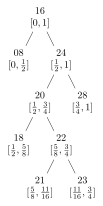
For reference, this set of nested intervals might be stored in a tree data structure like so:
1.2. Observations
Several key observations about our chosen integer coordinate system:
- The center point index of a cell, \(\mathtt{c}\), is never the center point of another cell.
Therefore cell center point indexes may be used as a unique identifier for the cell. - A cell's depth or level is counted from the top cell (level zero) down. The level is \(\mathtt{P-1-ctz(c)}\).
- The indexes of a cell's end points are \(\mathtt{c}\pm\mathtt{c\,\&\,(\tilde{} c + 1)}\)
- The \(x\) value for an index may be computed as \(x=x_{min}+\frac{x_{max}-x_{min}}{2^P}i\)
The first observation implies we can use a hash map keyed on the center integer index instead of a tree data structure! This allows us to make use of the well optimized integer key hash map data structure included in most modern programming languages. The third and fourth items on our list imply that we do not need to store domain coordinates for cell corners, i.e. the \(x\) values in the domain. So not only can we use a standard data structure, but we only need to store one value per cell. Additionally the formulas in the last three items allow us to compute a great many geometrically interesting things in constant time (\(\mathcal{O}(1)\)) directly from the index value and fixed constants.
To emphasize the level of algorithmic and computational simplification this implies, consider the problem of determining a cell's depth in the tree when using
a traditional data structure. For tree data structures, this is usually done via tree traversal utilizing a "back pointer" stored in each node that points
from child to parent. Note this is a RAM for performance trade-off in storing extra data in each cell. To compute the depth in such a scheme, we follow the
pointers for each parent until we hit the top of the tree. That amounts to a complexity of \(\mathcal{O}(\log_2(n))\) – not bad in the scheme of things.
Unfortunately it's a very hard \(\log\) on modern hardware because every time we follow a pointer on the heap we potentially access distant memory locations
causing an expensive cache miss. This poor cache behavior leads to a dramatic performance hit. For this reason some tree implementations decide to save
computational time at a cost of additional RAM by storing cell depth and other "metadata" in each cell. For
MRPTree this is a simple integer computation performed on the cell center index.
1.3. Generalizeing to Other Dimensions
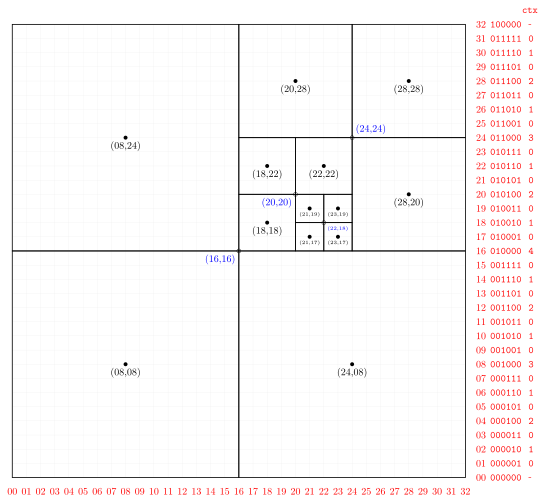
Generalizing our 1D example to \(\mathbb{R}^n\) is a simple matter of forming cross products of our construction in 1D! We use the same integer coordinate
systems on each axis. We then form our integer key as the concatenation of the coordinate integers for each point. For example in the following, \(P=5\), quad
tree the center point is at coordinates \((16,16)\). So we might pack these two values in a 16-bit integer as \(\mathtt{0001000000010000 = 0x1010}\). We can
pack multidimensional tuples into native integers, or we can use more sophisticated data structures like C++'s std::bitset. All that matters is that our
data structure choice is hashable in our language of choice.
Note this indexing scheme means we can consider geometric slices, as in "level sets", of higher dimensional trees by fixing one or more coordinates. In doing so we create lower dimensional trees at essentially zero cost – both in time an memory. By limiting the range of the free indexes of such a tree to a single hyper-quad, we can extract a side of a hyper-quad as a tree – again at essentially zero cost.
2. Integer Coordinates: Notation & Basic Observations
- \(P\) – The mesh power of the rectilinear tree
- \(D\) – The dimension of the rectilinear tree
- \(\mathbb{Z}_{k}\) – Non-negative (unsigned) integers less than \(k\). \[\mathbb{Z}_{k} = \left\{ i\in\mathbb{Z} \,\vert\, 0\le i\lt k \right\}\]
- \(\mathcal{L}=\mathbb{Z}_{2^P+1}^D\) – The \(D\) dimensional integer lattice where integer coordinates are defined.
As usual, the power set of \(\mathcal{L}\) is written \(2^\mathcal{L}\).
We use \(\vec{\mathbf{n}}=[n_1, ..., n_D]\in\mathcal{L}\) for general elements of \(\mathcal{L}\). When \(D=1\), we use \(n\) instead of \(\vec{\mathbf{n}}\). - \(\mathcal{C}\subset\mathcal{L}\) – The subset \(\mathcal{L}\) corresponding to coordinates that can be used as a cell center.
As usual, the power set of \(\mathcal{C}\) is written \(2^\mathcal{C}\).
We use \(\vec{\mathbf{c}}=[c_1, ..., c_D]\in\mathcal{C}\) – for general elements of \(\mathcal{C}\). When \(D=1\), we use \(c\).
The set of cells and cell centers are in 1-1 correspondence, and thus we use the cell centers to identify cells.
As such, when we speak of a "set of cells", we are actually referring to a set of "cell centers" (integer coordinate tuples). - \(L(\vec{\mathbf{c}}) : \mathcal{C} \rightarrow \mathbb{Z}_P\) – Level of cell \(\vec{\mathbf{c}}\) \[L(\vec{\mathbf{c}}) = (P-1)-\mathrm{ctz}(c_1)\] Note that \(\mathrm{ctz}(c_i)=\mathrm{ctz}(c_j)\) for all indexes of \(i\) & \(j\). i.e. the levels of all coordinate components are equal.
- \(H(\vec{\mathbf{c}}) : \mathcal{C} \rightarrow \mathbb{Z}_{2^P+1}\) – Half the width of the cell.
\[H(\vec{\mathbf{c}})=2^{P-L(\vec{\mathbf{c}})-1} = 2^{\mathrm{ctz}(c_1)}\]
This is just \(c_1\) with all bits cleared except the least significant one bit.
If we set \(\mathtt{c}=c_1\), then \(H(\vec{\mathbf{c}}) = \mathtt{c\,\&\,(\tilde{} c + 1)}\) - \(W(\vec{\mathbf{c}}) : \mathcal{C} \rightarrow \mathbb{Z}_{2^P+1}\) – The width of the cell. \(W(\vec{\mathbf{c}}) = 2 H(\vec{\mathbf{c}})\)
- \(A(\vec{\mathbf{c}}, d) : \mathcal{C}\times\mathbb{Z}_P \rightarrow \mathcal{C}\) – Ancestor of level \(L(\vec{\mathbf{c}})-d\).
\(A(\vec{\mathbf{c}}, 0)=\vec{\mathbf{c}}\).
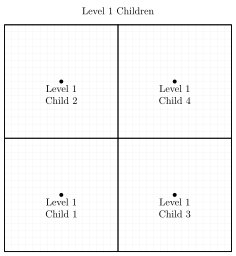
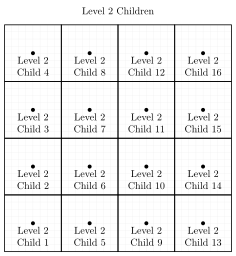
We call \(A(\vec{\mathbf{c}}, 1)\) the parent, and \(A(\vec{\mathbf{c}}, 2)\) the grandparent. - \(C(\vec{\mathbf{c}}, d) : \mathcal{C}\times\mathbb{Z}_P \rightarrow 2^\mathcal{C}\) – The set of children of level \(L(\vec{\mathbf{c}})-d\).
\(C(\vec{\mathbf{c}}, 0)=\vec{\mathbf{c}}\).
We call \(C(\vec{\mathbf{c}}, 1)\) the children, and \(C(\vec{\mathbf{c}}, 2)\) the grandchildren.
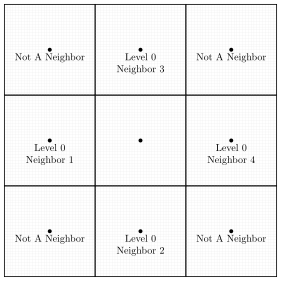
- \(N(\vec{\mathbf{c}}, d) : \mathcal{C}\times\mathbb{Z}_P \rightarrow 2^\mathcal{C}\) – Neighbors of level \(L(\vec{\mathbf{c}})-d\).
In the case \(d=0\), this set will be neighbors of the same "size" – i.e. the \(H\) of each neighbor will be \(H(\vec{\mathbf{c}})\).
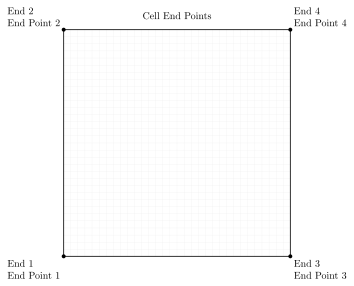
- \(E(\vec{\mathbf{c}}) : \mathcal{C} \rightarrow 2^\mathcal{L}\) – The set of cell endpoints (i.e. the corners of the cell hyper-rectangle) \[E(c)= \left\{ c-H(c), c+H(c) \right\} \] \[E(\vec{\mathbf{c}})=E(c_1) \times \cdots \times E(c_D)=\prod_{j=1}^{D}E(c_j)\]
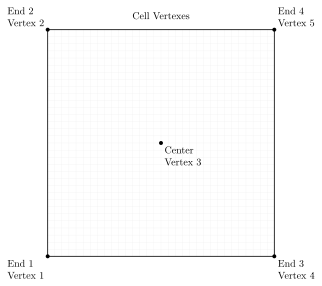
- \(V(\vec{\mathbf{c}}) : \mathcal{C} \rightarrow 2^\mathcal{L}\) – The set of vertexes of a cell are the cell's endpoints and the center. \[V(\vec{\mathbf{c}}) = E(\vec{\mathbf{c}}) \cup \{\vec{\mathbf{c}}\}\]
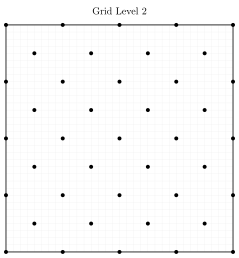
- \(G(\vec{\mathbf{c}}, d) : \mathcal{C}\times\mathbb{Z}_P \rightarrow 2^\mathcal{L}\) – Grid Points. The vertexes of \(C(\vec{\mathbf{c}}, d)\)
\[G(\vec{\mathbf{c}}, d) = \bigcup_{\vec{\mathbf{c}'}\in C(\vec{\mathbf{c}}, d)} V(\vec{\mathbf{c}'})$ \] Note \(G(\vec{\mathbf{c}}, 0) = V(\vec{\mathbf{c}})\)
- \(\hat{R}(K) : 2^\mathcal{L} \rightarrow \mathcal{L}\) & \(\check{R}(K) : 2^\mathcal{L} \rightarrow \mathcal{L}\) – Upper, and lower, bounding rectangle coordinates for a set of coordinates \(K\)
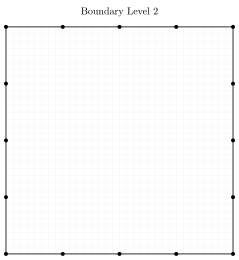
\[\hat{R}(K) = [\max_{n\in K}(n_1), \max_{n\in K}(n_2), ..., \max_{n\in K}(n_D)] \] \[\check{R}(K) = [\min_{n\in K}(n_1), \min_{n\in K}(n_2), ..., \min_{n\in K}(n_D)] \] Both \(\hat{R}(K)\) & \(\check{R}(K)\) are vectors, and subscripts refer to components. Ex: \(\hat{R}_i(K)\) - \(B(\vec{\mathbf{c}}, d) : \mathcal{C}\times\mathbb{Z}_P \rightarrow 2^\mathcal{L}\) – Boundary Vertexes of \(V(\vec{\mathbf{c}})\). \[B(\vec{\mathbf{c}}, d) = \{ \vec{\mathbf{c}'}\in V(\vec{\mathbf{c}}, d)\,\,\vert\,\,\exists i\in\mathbb{Z}_{P+1} \mathrm{with}\, \vec{\mathbf{c}'}_i=\hat{R}_i(K)\, \mathrm{or}\, \vec{\mathbf{c}'}_i=\check{R}_i(K) \} \] Note \(B(\vec{\mathbf{c}}, 0) = E(\vec{\mathbf{c}})\)
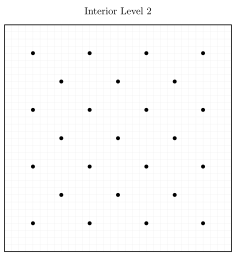
- \(I(\vec{\mathbf{c}}, d) : \mathcal{C}\times\mathbb{Z}_P \rightarrow 2^\mathcal{L}\) – Interior Vertexes of \(V(\vec{\mathbf{c}})\). \[B(\vec{\mathbf{c}}, d) = V(\vec{\mathbf{c}}) \setminus B(\vec{\mathbf{c}}, d) \] Note \(I(\vec{\mathbf{c}}, 0) = \{\vec{\mathbf{c}}\}\)
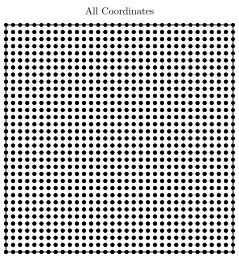
- \(Q(\vec{\mathbf{c}}) : \mathcal{C} \rightarrow 2^\mathcal{L}\) – The set of all coordinates (all integer lattice points) contained in the cell \[Q(c)=\{ j\in\mathbb{Z}_{P+1} | E_0(c) \le c \le E_1(c) \}\] \[Q(\vec{\mathbf{c}})=Q(c_0) \times \cdots \times Q(c_n)=\prod_{j=0}^{n-1}Q(c_j)\]
3. Enumerating Integer Coordinate Sets
Here we use the word enumeration from the field of computer science where it refers to the ability to traverse a data structure in a specific order. Many of the functions defined in the previous sections have a range of \(2^\mathcal{L}\) or \(2^\mathcal{C}\), and as a practical matter it is advantageous to place an unambiguous order on these sets.
When enumerating these sets we use the lexicographic ordering, and we use subscripts to denote the elements. For example: \[E(\vec{\mathbf{c}})= \{ E_0(\vec{\mathbf{c}}), E_1(\vec{\mathbf{c}}), , ..., E_{2D}(\vec{\mathbf{c}}) \} \]
4. Real Coordinates
- \(\mathcal{F}=\mathbb{R}^D\) – The real domain vector space within which cells are defined
- \(\hat{X}\) & \(\check{X} \in \mathcal{F}\) – Upper, and lower, points defining the rectangle within which our cells are defined
- \(\mathcal{D}=\{x\in\mathcal{F}|\check{X}_i\le x_i\le\hat{X}_i\}\) – The real domain rectangle within which cells are defined
- \(\Delta_D = \hat{X}-\check{X} \in\mathbb{R}^D\) – The overall width of the domain in each dimension.
- \(\Delta_X = \frac{\Delta_D}{2^P} \in\mathbb{R}^D\) – The distance between closest grid points
\(X(\vec{\mathbf{n}}) : \mathcal{L} \rightarrow \mathcal{D} \subset \mathcal{F}\) – The \(\vec{\mathbf{x}}\) value associated to the index in the domain space of the function
\[X(\vec{\mathbf{n}}) = \check{X} + \Delta_X * \vec{\mathbf{n}} \] Where \(*\) is vector pairwise multiplication: if \(c=a*b\), then \(c_i=a_i\cdot b_i\).
5. Cell Tessellation
By tessellation we mean partitioning of both the domain and range spaces for the tree into useful parts.
Of course the leaf cells themselves form a tessellation of the domain space, and this tessellation imposes a tessellation upon the range space. If the cells of the imposed tessellation are rectilinear, then using the cells directly is frequently the best approach. In some applications the cells in the range space are not truly "rectangular". For example, if we map 2D square cells of the domain into "quads" in the range via a parametric function, then the cells in the range space are frequently not even quadrilaterals. In such cases using the cells directly may lead to unsatisfactory results unless the tree is perfectly balanced. In this case we may archive better results by tessellation into triangle'ish parts.
What follows is a description of how to deal with 2D domains; however, the generalization to other dimensions is trivial. For example, with a three dimensional domain we simply have pyramids extending from the center point to the sides instead of triangles. For a 1D domain, we have line segments extending from the cell centers.
We triangulate 2D cells such that:
- Every triangle has precisely one vertex at the center of the quad
- Every triangle has precisely two vertices in the boundary of the quad
- Every quad boundary point is a vertex of two triangles
- Triangles only overlap on edges and vertices
- A triangle vertex is a vertex of every triangle containing it
- No triangles are degenerate (area zero or three co-linear vertexes)
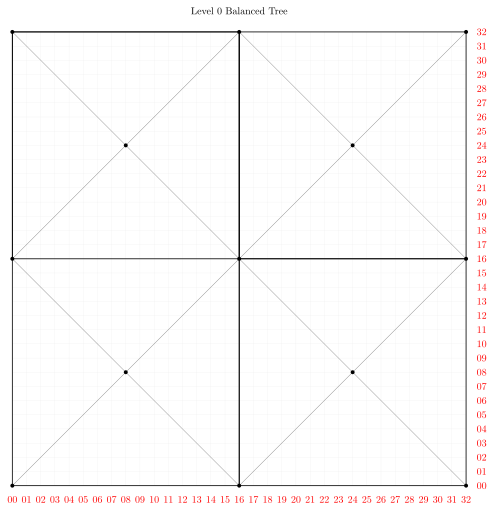
If all quads are the same size, we say the tree is balanced level 0 (i.e. the depth of all neighboring quads are equal). This situation is illustrated below:
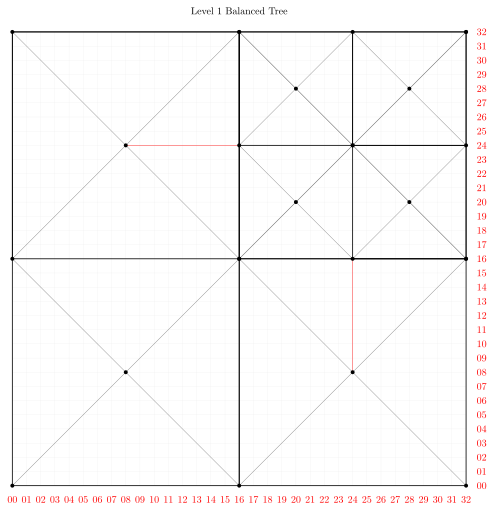
If some quads differ in depth from neighboring quads by at most 1, then we say the tree is balanced at a depth of level 1. This balance level is frequently considered as a requirement for quadtrees used as computational meshes. For meshes intended for visual use, the level may safely be made much higher.
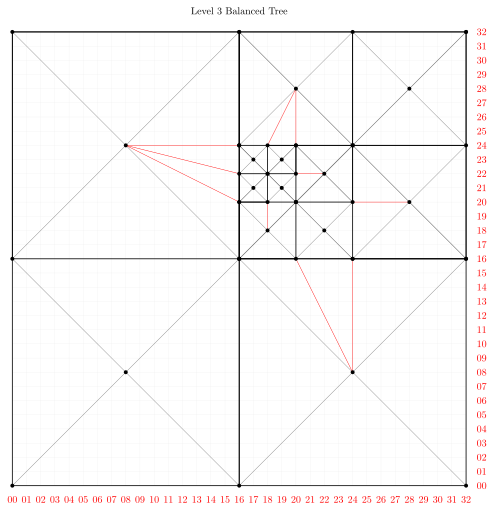
Higher balance levels are frequently used for quadtrees used to represent surfaces in visualization pipelines. The groups of triangles emanating from the center are frequently called "fans" in this case. Here is a level 3 example: